


Most teams start evaluating IPaaS pricing with a simple question. How much will this cost us each month? That question rarely survives first contact with production data. Pricing that looks predictable in demos begins to shift once HRIS, payroll, ATS, and benefits integrations go live. Payroll runs concentrate traffic into narrow windows. Retries inflate execution counts. Retroactive changes and deduction corrections introduce volume that pricing models were not designed to absorb.
For HR tech platforms, benefits providers, and retirement administrators, this is where pricing becomes an architectural concern rather than a line item. Engineering teams want to know which parts of integration behavior are metered and which are owned by the platform. Product leaders need clarity on whether deeper data models increase cost or remain stable at scale.
Operations teams need confidence that payroll cycles and enrollment periods do not introduce surprise spend. This pressure is reflected in market growth, with IPaaS adoption expanding at a CAGR of 19.5% and projected to reach USD 24.1 billion by 2033 as more companies move core systems into managed integration layers.
This guide breaks down how IPaaS pricing models actually behave in HR, payroll, and benefits environments, where hidden costs tend to surface, and how to evaluate pricing structures that align with long-term integration ownership rather than short-term usage.
At a Glance
- Payroll rejections, backfills, and corrections silently multiply billable actions after go-live.
- Task- and event-based pricing shifts vendor instability and schema drift back onto customer engineering teams.
- Payroll periods, eligibility windows, and retroactive changes do not map cleanly to stateless automation pricing.
- Teams handling deductions, multi-EIN employers, or write-backs experience higher IPaaS costs than read-only use cases.
- Pricing aligned to unified HR models and connection ownership remains predictable during payroll cycles and enrollment spikes.
What “iPaaS Pricing” Usually Means
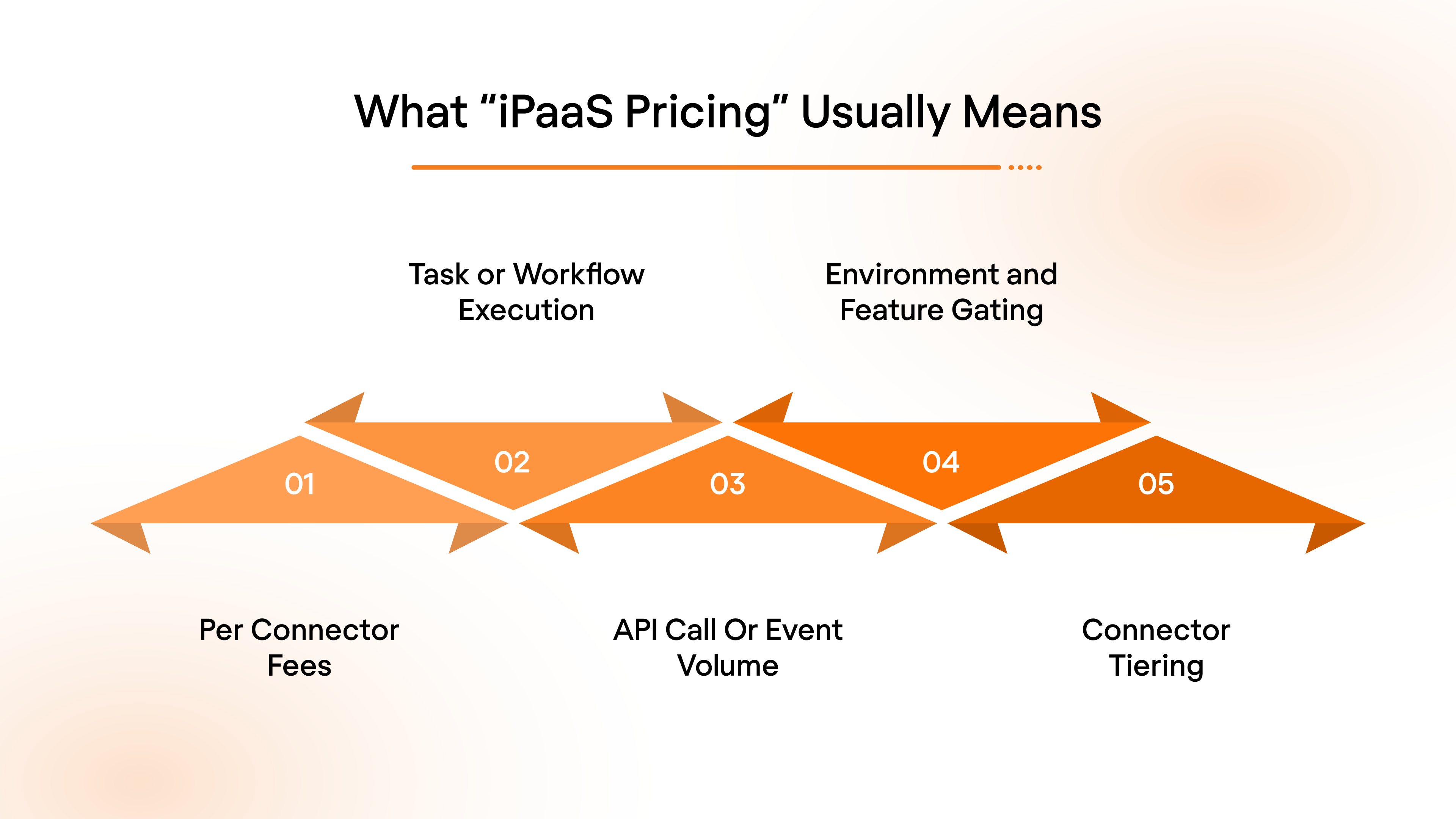
When buyers evaluate iPaaS pricing, they typically encounter cost structures tied to platform activity rather than integration ownership. These models prioritize platform usage metrics, which can diverge from real-world HR and payroll integration behavior.
- Per Connector Fees: Charges are applied for each third-party system enabled, often counted separately for production, sandbox, and regional variants.
- Task or Workflow Execution: Pricing based on the number of executed steps, events, or jobs, including retries triggered by downstream system failures.
- API Call Or Event Volume: Metered limits on requests, webhooks, or data sync events, with overage fees during peak loads.
- Environment and Feature Gating: Additional costs for production access, advanced monitoring, versioning, or enterprise controls.
- Connector Tiering: Core connectors are included at base tiers, while complex or regulated systems require premium plans or custom pricing.
Most iPaaS pricing models monetize activity and scale, not integration depth or operational responsibility. This mismatch becomes visible once integrations move into production workloads.
iPaaS Pricing Models Compared
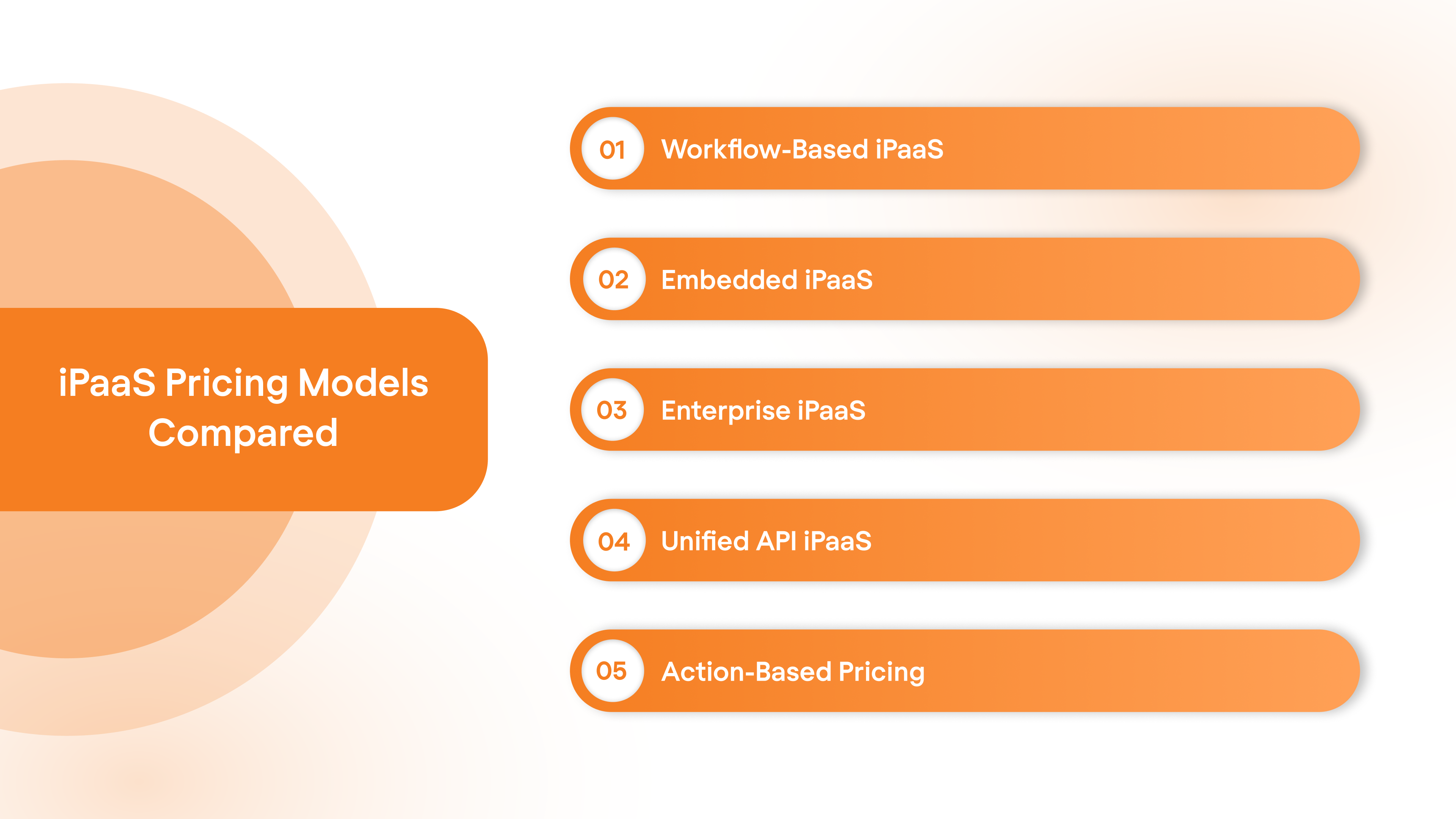
iPaaS pricing models differ based on how platforms abstract integrations, meter usage, and assign responsibility for failures, schema drift, and vendor changes. These differences surface quickly once integrations operate against production HR, payroll, or financial data.
1. Workflow-Based iPaaS
Workflow-based iPaaS platforms price integrations as chains of triggers and actions executed at runtime, optimized for short-lived automations rather than persistent system syncs.
- Task Metering: Each trigger, transformation, conditional branch, and retry is counted as a billable unit. For example, syncing one employee update across HRIS, payroll, and benefits can consume dozens of tasks.
- Retry Amplification: A failed payroll sync that retries across multiple vendors multiplies task usage, increasing cost during incidents rather than stabilizing it.
- State Handling Gaps: Long-running states such as payroll periods, benefits eligibility windows, or retroactive corrections require custom logic outside the workflow model.
2. Embedded iPaaS
Embedded iPaaS platforms charge SaaS companies to embed integration flows directly inside their product, abstracting authentication and UI while leaving data depth decisions to the buyer.
- Per Customer Or Connection Pricing: Costs increase with each customer-linked HR or payroll account, even if usage is low. For example, onboarding a large employer with multiple payroll entities multiplies pricing.
- Surface-Level Normalization: Common objects like “employee” or “job” are standardized, but deeper models, such as deductions, pay groups, or dependents, require custom extensions.
- Shared Runtime Limits: Concurrency and throughput limits apply across all embedded customers, which can bottleneck payroll runs or open enrollment traffic.
3. Enterprise iPaaS
Enterprise iPaaS pricing reflects infrastructure scale, governance, and deployment flexibility, primarily designed for internal IT teams orchestrating systems like ERP, CRM, and data warehouses.
- Capacity-Based Licensing: Pricing tied to committed message volume, cores, or environments. A payroll spike or year-end audit can exceed contracted capacity.
- Heavy Implementation Overhead: Initial setup often requires weeks of configuration and professional services before the first HR integration reaches production.
- Vendor Change Ownership: When an HRIS or payroll API changes behavior, internal teams must update mappings and logic, increasing long-term maintenance cost.
4. Unified API iPaaS
Unified API iPaaS platforms price integrations based on maintaining a single standardized API across many vendors within a specific domain.
- Integration Depth Coverage: Pricing reflects support for complete domain models such as employment, compensation, payroll runs, time off balances, and deductions. For example, benefits deductions are handled consistently across payroll vendors.
- Vendor Behavior Absorption: API changes, versioning differences, and file-based payroll feeds are handled by the platform, not the customer.
- Predictable Cost Under Load: Payroll cycles, retroactive adjustments, and enrollment spikes do not inflate usage-based charges because pricing is decoupled from event volume.
5. Action-Based Pricing
Action-based pricing bills every discrete execution step inside an integration flow. While it appears predictable in demos, it becomes unstable once integrations move into production HR and payroll environments.
- Hidden Step Multiplication: A single employee update can trigger validation, enrichment, branching logic, vendor-specific mapping, write operations, and confirmation checks. One logical sync routinely expands into 20–40 billable actions.
- Failure-Driven Cost Inflation: Payroll systems frequently reject records due to timing, lock windows, or formatting differences. Each rejection triggers retries, compensating actions, and reconciliation steps that all count as additional actions.
- Correction Penalties: Retroactive payroll fixes and benefits adjustments generate new action chains, even when the original data was correct, increasing spend during the most sensitive operational periods.
Each iPaaS pricing model encodes assumptions about where complexity lives. For production HR and payroll integrations, models that price integration depth and vendor ownership provide clearer cost predictability than models that price execution volume.
Reduce integration build time from months to minutes. See how Bindbee handles HRIS, payroll, and ATS connectivity.
How to Evaluate iPaaS Pricing for HR, Payroll, and Benefits

Evaluating iPaaS pricing for HR, payroll, and benefits requires looking past headline rates and examining how cost maps to integration depth, operational ownership, and production behavior. The goal is to assess whether pricing aligns with real HR data workloads rather than abstract platform usage.
- Pricing Unit Alignment: Validate whether pricing is tied to customer connections or metered activity. HR and payroll systems generate cyclical spikes where usage-based pricing distorts true cost.
- Model Coverage Scope: Confirm which unified models are included at each tier, such as employee-only versus full read-write coverage across employment, compensation, time off, and payroll data.
- Write And Sync Capabilities: Review whether pricing includes write access, webhooks, and configurable sync frequencies needed for lifecycle updates, deductions, and roster loads.
- Operational Ownership Boundaries: Determine who absorbs vendor API changes, retries, monitoring, and incident handling. Platforms that externalize this work shift the hidden cost back to engineering teams.
- Customization and Deployment Needs: Assess whether advanced requirements such as embedded connection flows, custom integrations, data scoping, or regional or on-prem deployments are supported within the pricing structure.
Strong iPaaS pricing for HR systems reflects integration responsibility and data depth rather than raw platform activity. This evaluation approach surfaces long-term cost exposure before production scale.
Choose an integration approach that scales with your product and avoids long-term maintenance tradeoffs. Read Unified API vs. Embedded iPaaS: Which One Powers Growth?
When Traditional iPaaS Pricing Makes Sense, And When It Does Not
Traditional iPaaS pricing models align well with short-lived, internal automation scenarios. They break down when integrations become customer-facing, stateful, and tied to regulated HR, payroll, or benefits data.
Traditional iPaaS pricing works for internal automation but collapses under production HR workloads. Customer-facing payroll and benefits integrations require pricing aligned to depth and responsibility, not activity.
Understand how modern integration platforms support HR, payroll, and benefits workflows in production environments. Read 9 Key Benefits of iPaaS and How HR Tech Teams Use It.
Why Teams Choose Bindbee for Predictable HR Integration Pricing
Bindbee applies Unified API iPaaS pricing that reflects real HR, payroll, and benefits integration ownership. Instead of metering activity, Bindbee prices for production readiness, data depth, and ongoing operational responsibility.
- Connection-Based Pricing: Costs are tied to the number of customer HRIS or payroll connections, removing exposure to API call spikes during payroll runs or enrollment cycles.
- Deep Unified Models Included: Pricing accounts for full HR data coverage, from employee and employment records to compensation, time off, payroll, and deductions, not surface-level objects.
- Unlimited Runtime Usage: API calls, retries, and sync operations are not metered, eliminating overage risk caused by corrections, backfills, or vendor instability.
- Operational Burden Absorbed: Vendor API changes, schema drift, retries, and monitoring are handled by Bindbee rather than pushed back to customer engineering teams.
- Built for Regulated Workloads: Support for webhooks, data scoping, embedded connection flows, and region-specific or on-prem deployments aligns pricing with compliance-driven HR environments.
Bindbee’s pricing model matches how HR integrations behave in production. By charging for integration responsibility instead of platform activity, teams gain cost predictability while scaling critical payroll and benefits workflows.
Final Thoughts
Choosing the right IPaaS pricing model starts with understanding how integrations behave once they support real product workflows and where operational risk accumulates over time. Usage-based pricing works for lightweight automation. Generic platforms hold up when surface-level data consistency is sufficient. But when integrations directly affect revenue, compliance, and customer trust, pricing must reflect depth, ownership, and reliability rather than execution volume.
HRIS, payroll, ATS, and benefits integrations fall squarely into that category. They require stable data models, predictable sync behavior, and clear responsibility during payroll cycles, corrections, and audits. This is where Bindbee’s approach to IPaaS pricing fits. By aligning cost with integration responsibility instead of platform activity, Bindbee supports production-grade HR integrations without forcing engineering teams to absorb hidden operational burden.
Ready to evaluate IPaaS pricing for HR systems with long-term clarity? Book a Bindbee demo today.
FAQs
1. How does IPaaS pricing change once integrations move into production?
IPaaS pricing often increases after go-live due to retries, payroll spikes, backfills, and correction workflows that were not visible during testing. These behaviors raise IPaaS cost even when customer volume stays flat.
2. Why does IPaaS cost fluctuate during payroll and benefits cycles?
Payroll runs, open enrollment, and retroactive changes concentrate activity into short windows. Pricing models tied to actions, events, or API calls amplify cost during these periods, even though the underlying integration logic has not changed.
3. Does deeper data modeling affect IPaaS pricing?
In many platforms, deeper models indirectly raise IPaaS cost because additional fields trigger more transformations, validations, and retries. IPaaS pricing rarely separates data depth from execution volume unless the platform is domain-specific.
4. Can IPaaS pricing remain predictable for customer-facing HR integrations?
Predictable IPaaS pricing is possible when cost is based on connection ownership rather than runtime activity. This approach avoids cost spikes caused by retries, polling, and vendor-specific behavior in HR and payroll systems.
5. Why do two teams using the same IPaaS report very different costs?
IPaaS cost varies based on data behavior, not just usage. Teams handling payroll deductions, corrections, or multi-entity employers experience higher cost exposure than teams syncing basic employee records, even on the same plan.


.png)


